.jpg)
Facts at a glance
Sources and review dates- Restrooms
- Portable toilets only. DLNR states the park has no permanent restrooms and no running water or showers.The Maui Planning Commission approved two comfort stations and two outdoor showers in July 2026. They were not built as of this review.
- Showers
- None. DLNR states the park has no showers.
- Drinking water
- None. DLNR states there is no drinking water available in the park.
- Lifeguards
- Two towers at Big Beach, the only ones on the Mākena coast. The county publishes no schedule for them.
- Posted hazard
- DLNR posts a caution that the shore break can be very dangerous.
- Spinal injuries
- 33 recorded at Big Beach between 2009 and 2017, more than at any other beach in Hawaiʻi.Hawaiʻi Trauma Registry figure reported by The Maui News. The state health department separately names Big Beach as the site of the most spinal cord injuries in the state over the same period.
- Park area
- 164.4 acres.
- Accessibility
- No agency publishes a current accessibility inventory for the park. The approved facility project includes paved stalls intended to meet ADA requirements, but that is planned work rather than a description of current access.
Permanent hazard, not a forecast
The shore break is the hazard here, and wave height does not measure it
The shore break at Big Beach can be very dangerous.
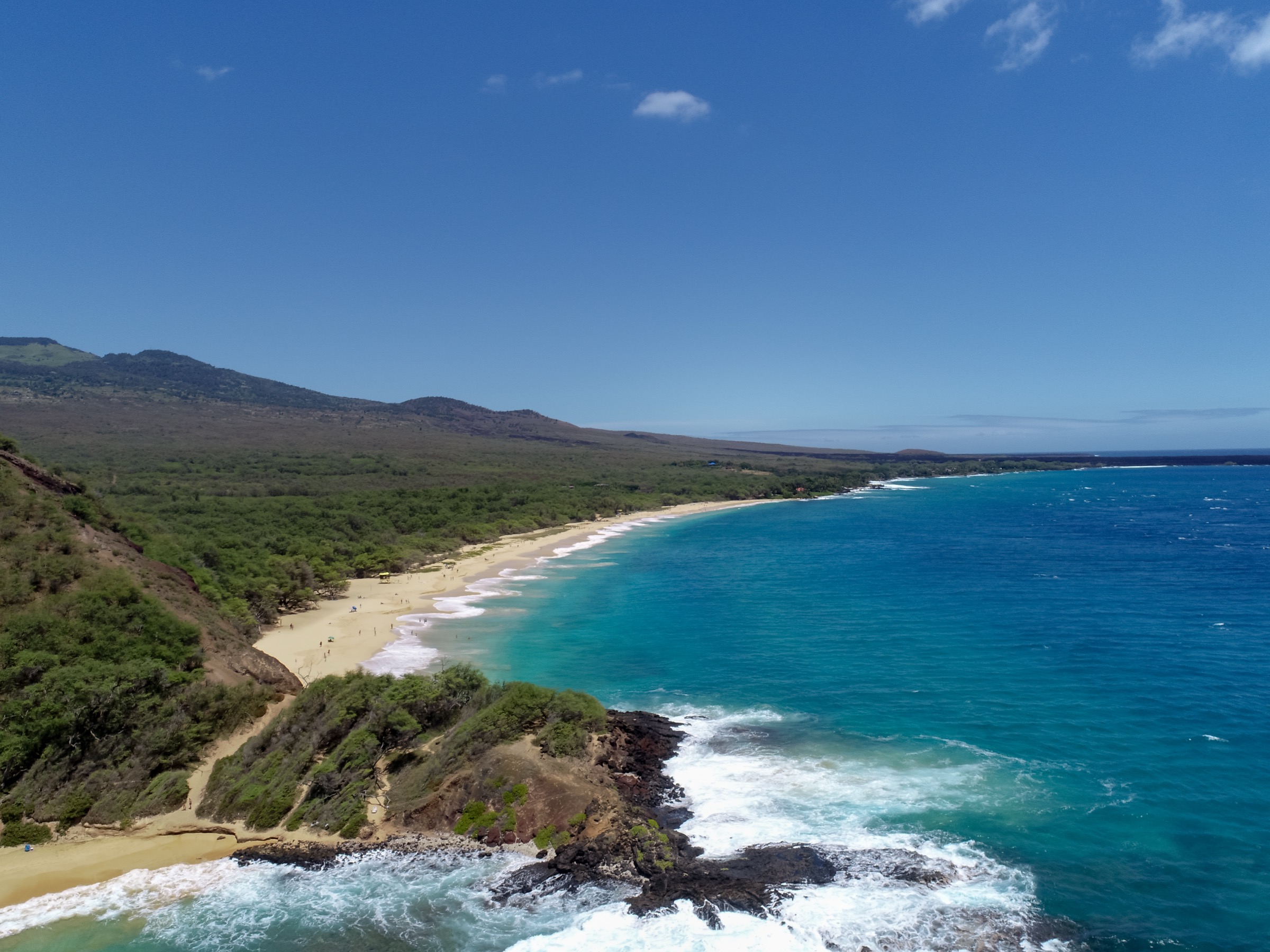
Waves at Big Beach break directly onto a steep sand face in very shallow water. That is what makes the shore break dangerous, and it is a property of the beach rather than of the surf on a given morning.
Wave height does not indicate shore-break safety. A calm-looking morning and a low surf forecast are not an all-clear for waves breaking directly onto the sand.
So watch how the water is breaking rather than how high it is. If waves are collapsing onto the sand instead of rolling in, that is the pattern, and it injures strong swimmers.
The Maui News, checked
The park has no plumbing
This deserves to be stated plainly, because a lot of beach listings describe Mākena as having basic facilities and that's misleading. DLNR's own 2022 environmental assessment says there are no permanent restrooms and no water supply infrastructure at the park for drinking water or showers, and that while portable toilets are provided, they don't provide an adequate sanitation level. That's the agency describing its own park.
In practice that's a bank of portable toilets near the Big Beach entrance and nothing else. No tap, no rinse, no fountain, for a beach that runs two-thirds of a mile with very little shade.
Bring more water than you think you need. That's the whole safety advice for a hot exposed beach with no water source, and it's more useful than a paragraph about hydration.
What was approved, and what exists
In July 2026 the Maui Planning Commission approved a special management area permit allowing State Parks to build two comfort stations, two outdoor showers and additional designated parking. The revised plan limits paved expansion while adding stalls intended to meet ADA requirements. Reporting at the time put construction about a year away.
So there is a real plan, and as of this review there were still portable toilets. Approved is not built. If a page tells you Mākena has restrooms, check when it was written.
Accessibility is not documented yet
Neither the park page nor the current facility records publish an accessibility inventory for the existing lots, paths or beach entries. The 2026 project approval mentions ADA-compliant paved parking as planned work, which does not establish that an accessible route to the sand exists today.
That is the useful answer until the state publishes one: accessible parking is part of the approved project, while current end-to-end access remains undocumented.
Two towers on 164 acres
County of Maui Ocean Safety records two lifeguard towers at Mākena State Park, and they're the only towers on this coast. Little Beach, Oneʻuli, Maluaka, Mākena Landing and Mākena Cove have none.
The county doesn't publish staffed hours for the towers. The closest thing to a figure is a 2019 Maui News report that Maui lifeguards are on duty from 8:00am to 4:45pm and that Mākena is one of nine beaches guarded year round. Treat that as a newspaper account from several years ago rather than a posted schedule: a tower is a structure, and whether someone is in it varies.
The service is a state purchase rather than a county one. State Parks pays the County of Maui for lifeguard coverage at Mākena, reported at more than $1 million a year, which is why the towers are here and not at the beaches immediately north.
Two towers is also a thin spread over a beach that runs two-thirds of a mile. If you are at the far end from a tower, you are a long way from the person whose job is watching the water, and that distance is worth factoring into where you put your towel if anyone in your group is a weak swimmer.
The number behind the shore-break sign
DLNR's posted caution is worth taking literally, and there is a figure attached to it. The Hawaiʻi Trauma Registry recorded 33 spinal injuries at Big Beach between 2009 and 2017, which The Maui News reported as the highest total for any beach in the state.
The state health department reaches the same conclusion from its own data, naming Big Beach as the site of more spinal cord injuries than anywhere else in Hawaiʻi over that period. This is a specific hazard at a specific beach, not a general warning about South Maui water.
Questions people ask
Does Mākena State Park have restrooms?
Portable toilets only. DLNR states the park has no permanent restrooms, no running water and no showers. Comfort stations were approved in July 2026 but not yet built as of this review.
Is there drinking water at Big Beach?
No. DLNR states there is no drinking water available in the park, so bring everything you plan to drink.
Are there showers at Mākena State Park?
No. Two outdoor showers were approved in July 2026. Maluaka Beach and Mākena Landing, north of the park, do have showers.
Which Mākena beaches have lifeguards?
Only Mākena State Park's main beach, with two towers. Little Beach, Oneʻuli, Maluaka, Mākena Landing and Mākena Cove have none.
What is the main hazard at Big Beach?
The shore break. DLNR posts a caution that it can be very dangerous, and the Hawaiʻi Trauma Registry recorded 33 spinal injuries at this beach between 2009 and 2017, more than at any other beach in the state.
Sources for this page
- Hawaiʻi DLNR, Division of State Parks: Mākena State Park
- Hawaiʻi DLNR, Division of State Parks: important park notices
- Hawaiʻi DLNR, Division of State Parks: Final Environmental Assessment, Mākena State Park Improvements (December 2022)
- Safe Beach Day, compiled with the Hawaiʻi Lifeguard Association and County of Maui Ocean Safety
- The Maui News: planning commission approves Mākena State Park expansion (July 2026)
- The Maui News: Maui beaches lead state in spinal injuries (24 July 2019), citing the Hawaiʻi Trauma Registry
- Hawaiʻi Department of Health, Hawaii Ocean Safety: drowning and spinal cord injury
This site is independent of Hawaiʻi DLNR, the County of Maui and emergency services.